
-4.png)
The retail landscape has been anything but predictable lately. Between tariff uncertainty, inflation concerns, and shifting consumer sentiment, the executives responsible for building and designing stores are navigating some seriously choppy waters.
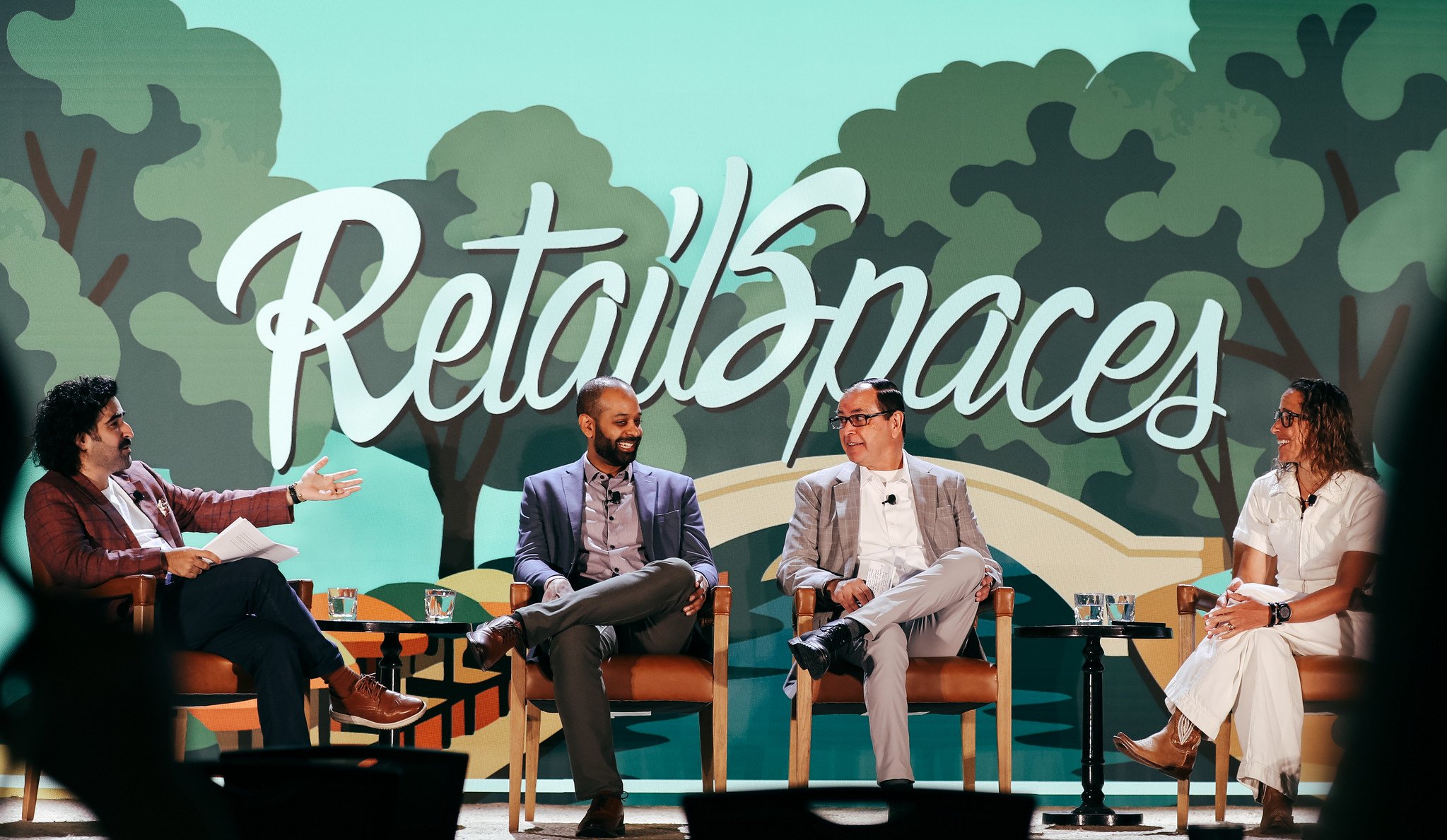
At RetailSpaces Fall in Miami Beach, Executive Producer Michael Owens sat down with Simeon Siegel, Senior Managing Director and Senior Retail Analyst at Guggenheim Partners, to cut through the noise and get his unfiltered take on where retail actually stands right now. Simeon spends his days buried in earnings calls and retail data, which means he's got a perspective that goes way beyond the headlines.
When Owens opened with "How screwed are we?" Simeon didn't hesitate: "We are, we are. This is retail. Come on!"
But here's the thing: he's also weirdly optimistic. As he put it, "We're always screwed and we're always optimistic. That's what this is, right?" And after the conversation, it's clear why.
The Consumer Sentiment Myth
Let's start with something Simeon feels strongly about: consumer sentiment surveys are basically useless.
"Show of hands, who has ever taken a survey before?" he asked the audience. When hands went up, he called bullshit. "Who has lied on said survey? You'd still have your hand raised."
His point? Americans love to complain about the economy, but they keep spending anyway. Holiday spending forecasts, sentiment indexes, none of it really predicts what people actually do with their wallets. The US consumer remains "overly resilient," as he puts it, whether the surveys reflect that or not.
What matters isn't what people say they'll do. It's whether you're offering something compelling enough to make them actually spend.
Tariffs Don't Raise Prices: Bad Businesses Do
This one caught people's attention. Simeon's take on tariffs is contrarian, but it makes sense when you think about it.
"Tariffs raise the cost of goods. They don't raise the price of goods," he explained. "The consumer raises the price of goods because they have to be the one to take it."
In other words, tariffs are just another cost input, like cotton prices going up or supply chain issues. Compelling brands with strong value propositions can absorb those costs or offset them elsewhere. Weak brands will try to pass everything through to customers, get met with resistance, and end up discounting anyway.
The real problem with tariffs? Uncertainty. When companies don't know what the rules will be next quarter, whether to nearshore, which countries might be protected, which products will get hit, that's what makes planning nearly impossible. It's not the tariff itself; it's the constantly moving target.
Stores Are Still the Best Part of Retail
Remember a few years ago when every earnings call was about digital transformation and everyone was writing obituaries for physical retail? Yeah, Simeon remembers that too.
"It was harder to be at RetailSpaces a few years ago," he admitted, referring to the post-COVID period when store development teams had to fight for every dollar. "You had to justify why you should be opening a store."
Thankfully, that's over. The industry has come back around to recognizing what should have been obvious all along: stores, when done well, are the most profitable channel.
Why? Because in e-commerce, the customer becomes the employee. They're doing the pick, pack, ship, fulfillment, and reverse logistics. In a store, they grab something off the shelf, walk to the register, pay, and carry it out themselves. They are the shipping vehicle.
Plus, and this matters, stores let you represent your brand in the strongest possible way. No algorithm or website can replicate that.
Not Everyone Wins: And That's How It Should Be
Here's where Simeon pushed back on doom-and-gloom narratives. Yes, things are harder than they were during the stimulus-fueled days of 2020-2021. But that's actually... good?
"In a good environment, bad operators are winning too," he said. "In a bad environment is when you set yourself apart. That's when really strong operators shine."
He pointed to the divergence between winners and losers in the same categories. Walmart versus Target. Nike versus Hoka. LVMH struggling while Hermès thrives. The market is doing what markets are supposed to do: rewarding the businesses that are actually good at what they do.
For the store development and design teams in the audience, this was the key message: if you're ambitious and believe you're good at your job, this is exactly the environment where you can prove it.
AI Is a Tool, Not an Identity
No retail conversation in 2025 would be complete without mentioning AI, so Owens asked Simeon for his take.
His response: "AI is important. AI matters. But AI is a tool."
He compared it to the direct-to-consumer craze from a few years back, when companies started defining themselves by how they sold rather than what they sold. That never ends well.
AI should be treated like any other back-office system: inventory management, allocation, vendor relationships. Use it where it makes sense, but don't let the buzzword become your identity. And definitely don't hand over front-of-office functions just because it's the hot thing to do.
The Outlook: Hard, But Not Hopeless
So where does that leave retail over the next year?
Simeon's view: consumers will keep spending, but market-share battles will be brutal. There will be winners and losers. Some businesses will struggle or fail. But that's business, that's what's supposed to happen.
"You run micro businesses, not macro businesses," Simeon emphasized. Yes, there are headwinds: tariffs, inflation, the dollar's decline, geopolitical uncertainty. There's always something. The question is whether you can adapt and play within those constraints. Focus on what you can control: building compelling spaces, creating strong value propositions, and being a great operator.
And for the real estate folks specifically, he offered this perspective: every new store location is a variable cost to them but becomes a fixed cost to the parent company, sales in perpetuity from a one-time buildout. That's a powerful story to tell your CFO when you're making the case for growth.
The Bottom Line
Retail isn't dying. It's just getting harder. And harder means the winners and losers are getting sorted out.
For the teams responsible for building and designing retail spaces, that's not necessarily bad news. It means the stores you're creating matter more than ever. It means efficiency matters, but so does creating brand experiences that can't be replicated online.
As Simeon put it, half-joking: "Stores are the best part of retail. Because stores are the way it was supposed to be done."
Hard to argue with that.
Watch the full talk below 👇

Posted by
Reimagining Physical Retail.
RetailSpaces is a community store development and design innovators.
March 7-9, 2027 | Carlsbad, CA
Learn More!
-2.png)
-3.png)



Comments