
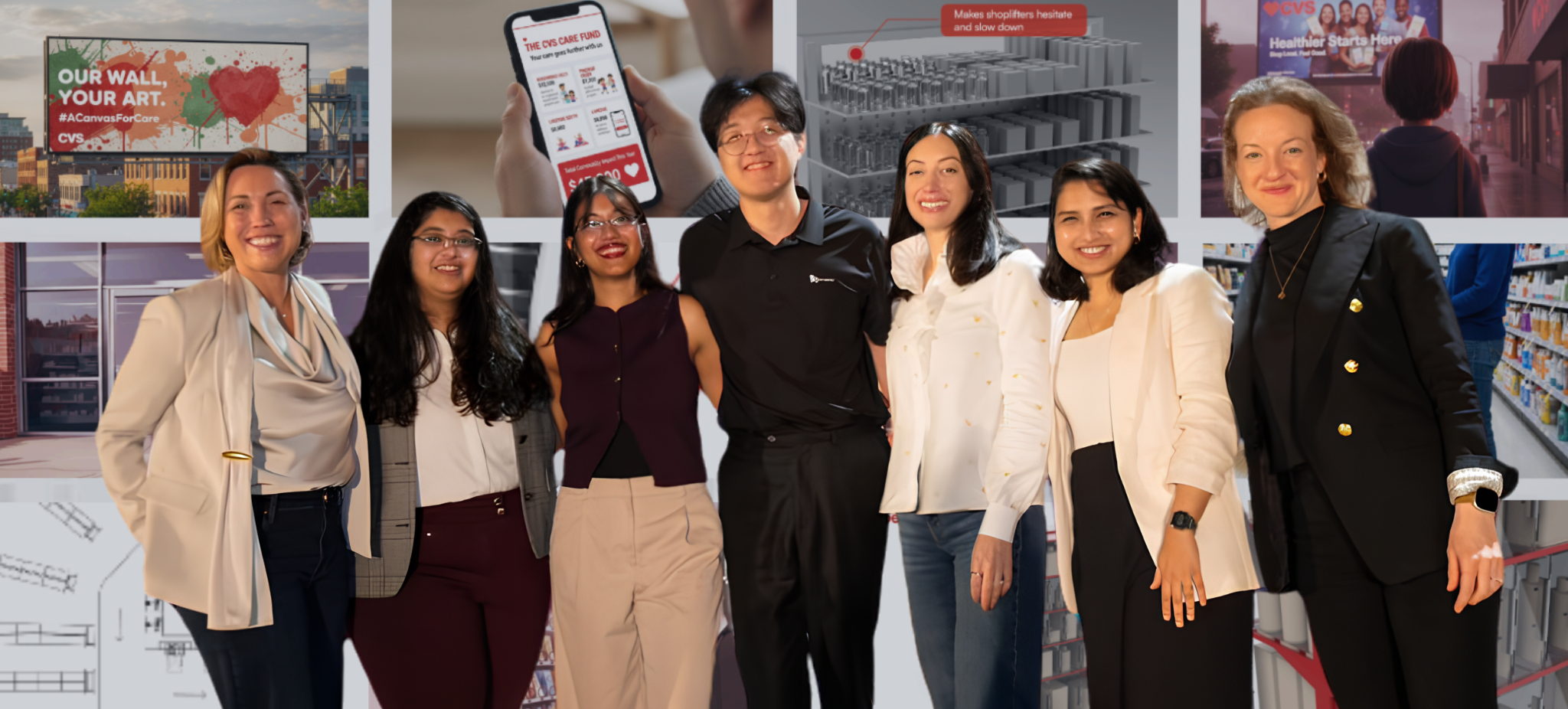
What do you get when one of America's largest pharmacy retailers gives a team of art school students two of its toughest store design challenges and tells them to question everything? Apparently, solutions worth piloting.
Rebecca MacLennan and Leigh-Ann Razza lead construction program management at CVS Health, overseeing thousands of capital projects annually across a national portfolio. They're very good at what they do. That, it turns out, was part of the problem.
"We have incredibly talented people in our organizations," MacLennan said at RetailSpaces Spring 2026, "but many of them have been solving the same categories of problems for the last decade. And sometimes that expertise is our blind spot."
Large organizations reward experience. The people who know the system. The people who remember what didn't work before. Which is valuable, until you need someone to ask a question nobody inside the building would think to ask.
"Are we solving today's challenges with yesterday's framing of the problem?"
Bringing In People Trained to Question the Brief
Razza studied design at SCAD and later at RISD, where she learned that design feedback wasn’t about judging the solution. It was about questioning the problem.
You pin your work on the wall feeling confident, and a professor asks one question: How did you frame that problem?
Sometimes the answer reveals that the real opportunity is somewhere else entirely.
That mindset led Razza and MacLennan to SCADpro, the innovation lab at the Savannah College of Art and Design, where multidisciplinary student teams collaborate with brands on real business challenges. Not as a nice-to-have, but as a strategic tool.
"To be clear, while CVS has a huge mission of giving back, this wasn't charity," MacLennan said. "This was strategy."
Seven Days. One Fixture. One Pilot.
The first project was a seven-day sprint focused on one of the least glamorous challenges in pharmacy retail: the waiting bin.
It's where prescriptions sit until customers pick them up. As prescription volume grows, that space becomes more crowded, making even small improvements meaningful for pharmacy operations.
CVS asked the students to rethink the fixture.
The students started by talking to people: pharmacists, internal stakeholders, and anyone who lived with the problem every day. They moved fast, prototyped quickly, and presented ideas CVS hadn't considered.
One of those ideas is already moving toward a pilot. CVS wouldn't reveal the concept because it's now part of its testing process.
Ten Weeks. Rethinking Loss Prevention.
The second project gave the students ten weeks and a much more complex challenge: loss prevention.
Not the usual security toolkit of cameras, locks, and guards. CVS asked the students to design a retail experience that helps prevent theft without making the store feel less welcoming for customers and employees.
The team of 18 students came from architecture, industrial design, graphic design, UX, interior design, writing, and design management, representing countries from India to Finland to Venezuela. They explored sight lines, color theory, sound and lighting psychology, cultural influences, and the subtle design cues that make someone feel watched versus welcomed.
They designed anti-swipe shelving with embedded sensors to make bulk theft harder and developed vending concepts for the highest-risk product categories.
But one idea stood out.
The students suggested interviewing people who actually commit retail theft and testing design concepts with them to understand what makes a space easier to steal from.
CVS's asset protection team embraced the idea.
"We wouldn't have thought of that without having these students and talking through this," MacLennan said.
One of the concepts from that ten-week project is now moving to pilot. MacLennan also noted that internal meetings around the project are now drawing 100 percent participation from senior leadership because the work earned it.
What CVS Actually Learned
The most valuable lesson wasn't any single design solution. It was the difference between two ways of solving problems.
Experienced teams optimize. They make existing systems faster, cheaper, and more efficient. That's valuable work.
But optimization assumes the problem has already been framed correctly.
The student teams did something different. They stepped back and asked whether CVS was solving the right problem in the first place.
"We optimize, they question the frame," MacLennan said. "And together, that's extremely powerful."
Not every organization needs an academic partnership to get there. But most organizations share the same blind spot CVS identified in itself: the longer you've been solving the same problem, the harder it becomes to see it differently.
Curiosity Is a Competitive Advantage
"The next generation isn't waiting to inherit retail," MacLennan closed. "They're already designing it."
That's true whether they're inside your company or outside it.
The question isn't whether fresh perspectives exist. It's whether established organizations are curious enough to invite them in.
Because when experience and fresh thinking work together, organizations don't just improve the way they operate.
They redefine what's possible.
Watch the full talk below...

Posted by
Reimagining Physical Retail.
RetailSpaces is a community store development and design innovators.
March 7-9, 2027 | Carlsbad, CA
Learn More!
-2.png)
-3.png)



Comments