
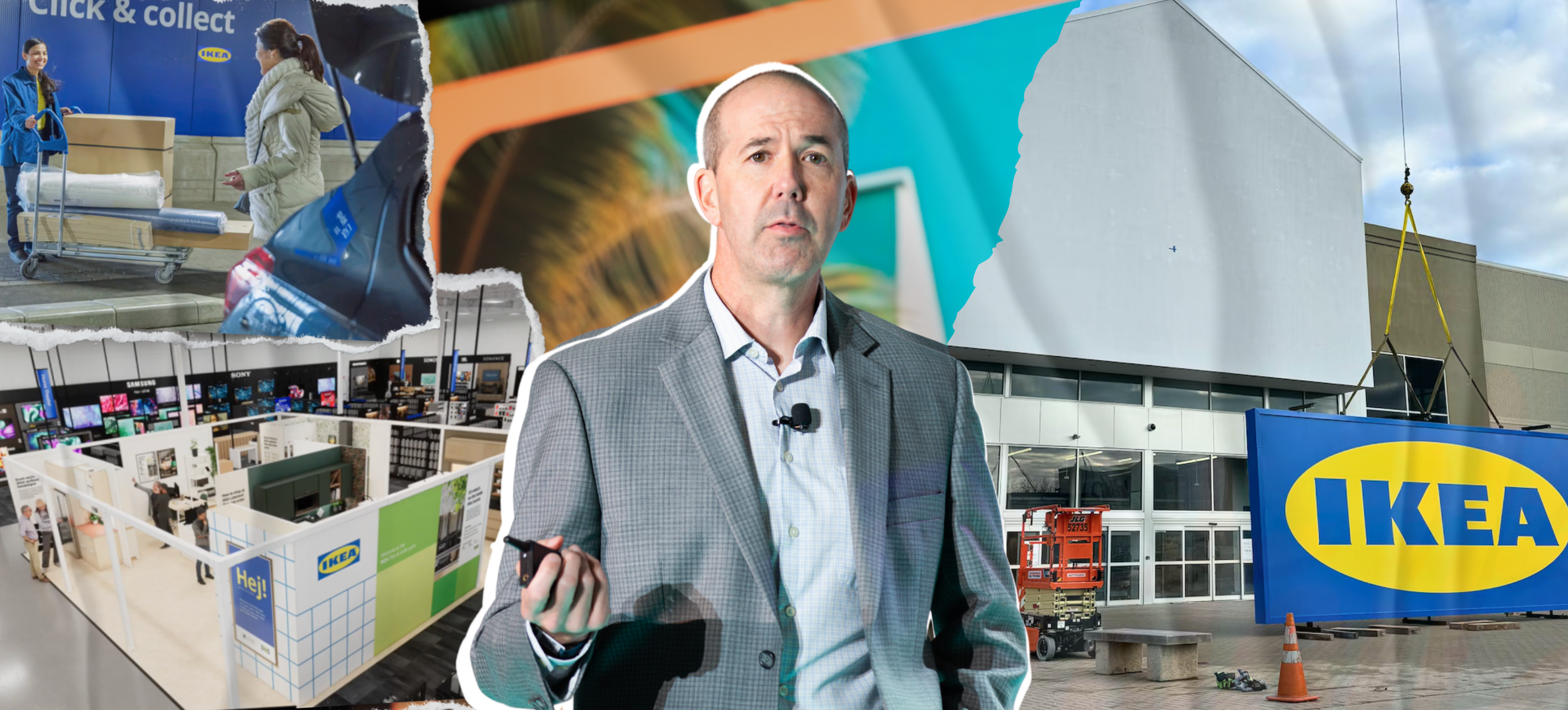
When Rob Olson, COO of IKEA US, stood before the RetailSpaces audience, he didn't open with success stories. He opened with failures—three of them, to be exact.
Planning studios that didn't work. An Upper East Side store they had to close. A Queens location that confused more customers than it served. Each one cost millions. Each one taught IKEA something essential about what customers actually need.
The Big Blue Box Problem
For 40 years, IKEA's formula worked: 300,000 square feet, a winding showroom path, maybe stop at the restaurant, grab your flat-pack furniture, load it yourself, drive home. Fifty-two stores from coast to coast, all built on the same blueprint.
Then consumer behavior shifted. "We realized we need to change and we needed to adapt to be able to really meet the consumer in the way they want to be met," Olson explained.
The question wasn't whether to change. It was how?
Failure as Education
IKEA's first attempt: planning studios where customers could design their kitchens and closets. They opened several globally. "This didn't work out," Olson said flatly. "This was a solution that we did stop just before COVID."
Second attempt: a larger "plan and order point" on Manhattan's Upper East Side. Failed again. Same story in Long Beach. "We realized that one of the biggest things that the customer needed beyond the planning was pickup capabilities."
Third attempt: a smaller retail outlet in Queens with a curated product selection. This one failed for a different reason. "Not having the long natural path that we have in our store actually confused the customer more than you might think."
That last insight deserves unpacking. IKEA discovered their famous maze-like layout isn't a bug—it's a feature. Customers had learned to navigate IKEA a certain way. Remove that structure entirely, and you don't simplify the experience. You break it.
What Actually Works
Armed with expensive lessons, IKEA developed their current expansion strategy: extra small plans and order points (think 5,000-10,000 square feet) and small stores (35,000 square feet—tiny by IKEA standards, massive by most retailers').
Cherry Hill, New Jersey. Beaverton, Oregon. Scottsdale, Arizona. San Marcos, Texas. Four opened in six months, with more coming.
The formula: curated range based on local sales patterns, but full access to everything IKEA sells for pickup. "We really listened to the customer, looked at the sales patterns, and created a curated range that would fit into these locations. But at the same time, you have full access to any products that we carry."
Customer response? "The feedback in the smaller units has been fantastic. It's actually above average in our ratings when we compare it across the locations."
The Omnichannel Reality Check
Here's the stat that should make every "stores are dead" prognosticator reconsider: 74% of IKEA's online sofa sales come from customers who sat in the sofa in-store first.
"They want the ability to stop into a physical location, touch and feel that sofa. See what the fabric is on a quilt cover," Olson explained. "So that they feel comfortable before they buy it, but then have the ease and convenience to go back home and actually make the purchase."
The store isn't competing with digital. The store enables digital.
The Partnership Play
IKEA's boldest move: opening inside Best Buy. Ten locations—five in Texas, five in Florida—starting November.
"We're trying the opposite," Olson said, contrasting IKEA's strategy with retailers who subdivide their own space. Instead of bringing partners into IKEA, they're going into partners' spaces.
The economics? "It takes time. It's about finding the right partner. We're rooted very heavily in our culture and values. So we need to find a partner that is also rooted in culture and values so that we have a good match."
Best Buy fit. The partnership took significant time to structure, but Olson's advice was simple: "Sit down and really operate in good faith and see where you're at."
Build Less, Reuse More
On new construction, Olson was blunt: "Mostly, no. Mostly we're trying to reuse existing square feet."
The reason isn't just economic. "The construction side of retail is equivalent to almost 80 years of operational impact from sustainability." Translation: building one new store creates the same environmental impact as operating an existing store for 80 years.
IKEA's sustainability infrastructure backs this philosophy: 95% of buildings have solar panels, two wind farms, conversion to renewable heating and cooling across all locations. They're using AI (specifically End Cycle technology) to optimize HVAC based on weather and traffic patterns, reducing electricity and gas usage by 5%.
The Results
Market share up 13% in the last five years, during what Olson acknowledged has been "a tough environment in the home furnishings industry."
That growth funds the transformation. Extra small plan and order points in markets like Huntsville, Alabama—"somewhere we never could imagine being if we were still a 300,000, 400,000 square foot location."
"With a 300,000 square foot building, you can only get into so many markets, so many cities," Olson concluded. "This gives us that opportunity to go into markets and get closer to the customer."
After 40 years of one playbook, IKEA wrote a new one. They did it by failing forward, listening to what those failures revealed, and accepting that what worked for four decades wouldn't work for the next four.
Watch his full talk below...
Want to join the next conversation?
Request an invite to RetailSpaces →
Posted by
Reimagining Physical Retail.
RetailSpaces is a community store development and design innovators.
March 7-9, 2027 | Carlsbad, CA
Learn More!
-2.png)
-3.png)




Comments