
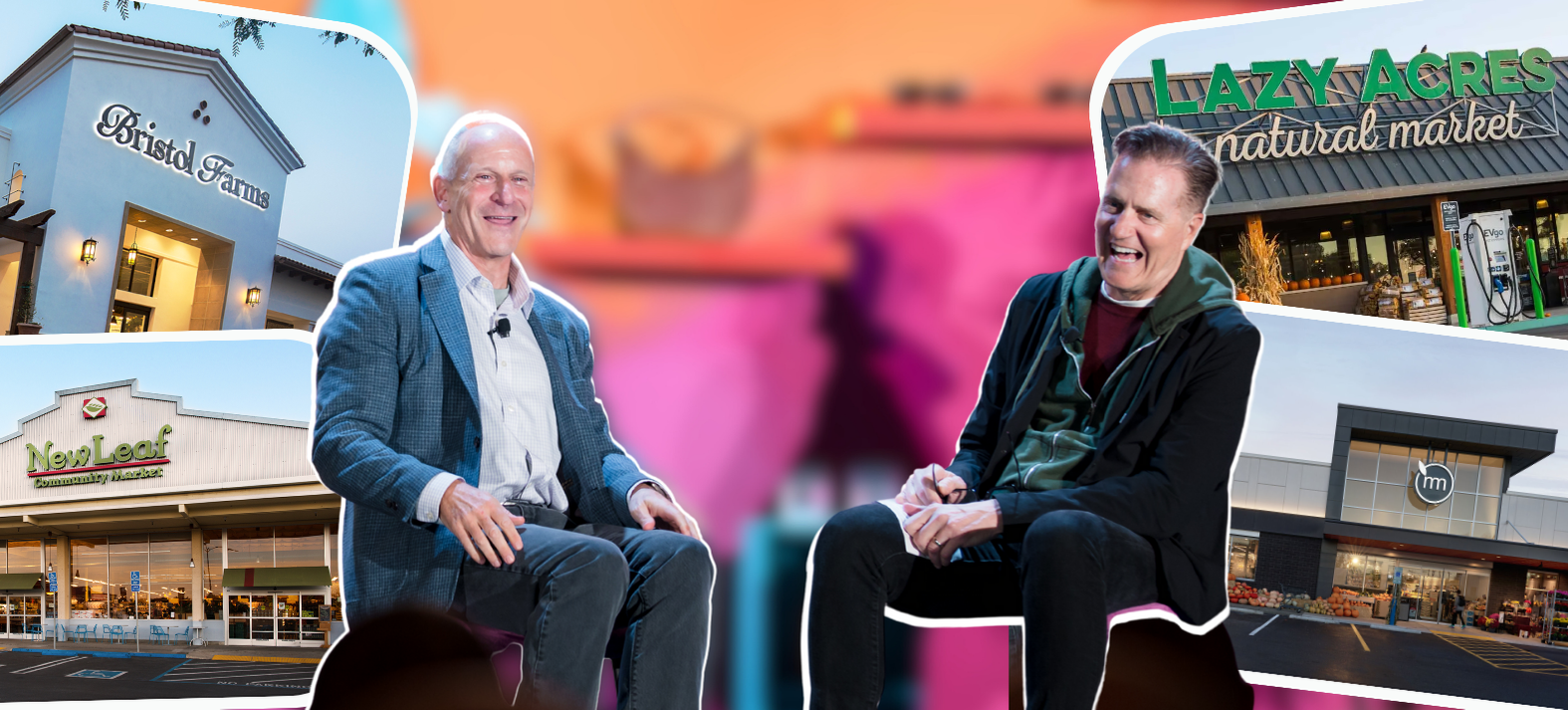
"I was so much smarter as a consultant," Neil Stern admitted with a laugh during his RetailSpaces conversation with retail strategist Lee Peterson. "Retail is so much harder."
The CEO of Good Food Holdings should know. After spending decades whispering strategy into the ears of retail executives, he made the leap five years ago from consultant to operator—trading his advisory role for the daily reality of running 57 stores across five distinct banners on the West Coast.
The Consultant's Revelation
Stern's transition from McMillan Doolittle strategist to grocery CEO wasn't planned. When COVID hit in 2020, his Korean client—the company behind a $3 billion retail success story—asked if he wanted to run their U.S. holding company. "I went from flying 250,000 miles a year working for retailers to sitting in my daughter's bedroom on Zoom calls," he recalled.
What he discovered on the other side of the conference table was humbling: "You know, I went from 20 people in our consultancy and I have 7,500 people working today within Good Food Holdings."
The scale wasn't just about numbers. "In consulting, we were basically saying, 'Hey, let's take a step back. Let's breathe. Let's talk about what we're gonna do for the next three years.' In the world of grocery, you're talking about what you're doing in the next 30 minutes, next 30 days."
Five Banners, One Vision
Good Food Holdings operates what might seem like competing brands: Metropolitan Market in Seattle, New Seasons in Portland, New Leaf in Santa Cruz, Bristol Farms in Southern California, and Lazy Acres Natural Markets. The genius lies not in the similarity but in the differentiation.
Take Bristol Farms and Lazy Acres, both serving affluent beach communities in Southern California. Bristol Farms in Manhattan Beach caters to an established, brand-conscious customer; "I'm a Bristol Farms customer. I've arrived. I'm a little bit older, a little bit more established." Meanwhile, Lazy Acres in nearby Hermosa Beach attracts "a younger customer who cares very much about what they're putting in their body. They care about where that product's coming from. They care about sustainability."
Competing by Being Different
Stern's strategy flies in the face of conventional grocery wisdom. While most supermarkets compete on price and promotion, Good Food Holdings has chosen a different path entirely.
"If it's about selling Cheerios at the lowest price, I lose," he said bluntly. "I've got these expensive stores in expensive neighborhoods, lots of service. I can't sell Cheerios at the lowest cost. So I've gotta give customers a different reason to come into our stores."
That reason centers on three core differentiators: winning in prepared foods, having the best fresh products in the market, and being the place for discovery of young and interesting brands. "I want those insurgent brands when they're young, and I can grow with them," Stern explained. "I'm not competing against Walmart on price."
The approach extends to their relationship with emerging brands. "Think about Rao's pasta sauce. We were selling Rao's when they were part of the little New York restaurant and we had it on our shelf for $9.99. Now it's sitting at Walmart for five bucks, and we're like, 'Okay, you're graduating. I want the next guy up.'"
The Power of Simple Vision
When asked about great leadership, Stern's answer was refreshingly straightforward: "Set a vision that is understood by the organization. A lot of companies would say, 'Here's our vision,' and it has eight pillars to it. If you went around the room and asked anybody, 'Can you name those eight pillars?' The answer is no."
Good Food Holdings' vision is intentionally simple: "Source, create and sell great food." But simplicity doesn't mean easy execution. "Build a management team capable of executing that vision—that's the part I've learned the hard way. Getting a management team that's on board is really hard."
Stern learned this through contrasting examples: "A fantastic regional supermarket I worked with had a management team together 25 years. I worked with another retailer about the same size, and they had an all-star team, they had the Yankees. They recruited the best merchants, the great marketers, but they weren't a cohesive team."
The Consultant's New Wisdom
Five years into his retail journey, Stern offers a perspective that only comes from living both sides of the strategy-execution divide. The consultant's tools—vision, differentiation, customer segmentation—remain essential. But the operator's reality adds layers of complexity that can't be solved in a conference room.
The uncertainty hasn't shaken his conviction in the strategy. If anything, it's reinforced the importance of being different in ways that matter to customers, whether that's the Bristol Farms customer who wants to impress dinner guests or the Lazy Acres shopper who cares about sustainability.
In a world where 30,000 supermarkets compete largely on price and promotion, Good Food Holdings has chosen to compete on something harder to replicate: authentic local relevance backed by exceptional execution. As Stern put it, "I gotta figure out a different way to do it."
Watch the full discussion below...

Posted by
Reimagining Physical Retail.
RetailSpaces is a community store development and design innovators.
March 7-9, 2027 | Carlsbad, CA
Learn More!
-2.png)
-3.png)



Comments